

Shake the bottle, divide the hair into workable sections and mist Heat Shield evenly through the mid-lengths and ends. Use it on damp hair before blow-drying or on dry hair before straightening or curling. Distribute the spray, avoid soaking one area and let visible moisture dry before a direct-contact hot tool touches the section.
The most common application error is not “too few sprays.” It is uneven coverage. The outer layer becomes wet while the hair underneath receives nothing, so the user adds more to the same surface. Sectioning fixes that problem better than a large final mist over the whole head.
The method at a glance
| Styling tool | Hair state when applying Heat Shield | Before the tool touches hair |
|---|---|---|
| Blow-dryer | Clean, towel-blotted damp hair | Distribute through sections; begin with controlled airflow |
| Diffuser | Evenly damp, styled curls or waves | Confirm product compatibility and distribute without disturbing the pattern |
| Flat iron | Clean, dry hair | Mist lightly, distribute and let any visible moisture dry completely |
| Curling iron or wand | Clean, dry hair | Mist lightly, distribute and let the section dry before wrapping |
| Hot brush | Follow the tool and product directions | Conventional dry-styling brushes require dry hair; confirm if the tool is designed for damp use |
The exact tool manual and current product label take priority. A tool marketed for damp hair has a different design from a conventional flat iron or curling wand.
Step 1: start with the right hair state
Before blow-drying
Gently squeeze out excess water and towel-blot. The hair should be damp, not dripping. Very wet hair takes longer to dry and makes it harder to judge how evenly a spray has been applied.
You can allow partial air-drying when the desired style, scalp comfort and texture permit it. Do not rough-rub the hair or twist it tightly in a towel.
Before straightening or curling
Begin with dry hair. If you wash first, complete the blow-dry or air-dry step before using the iron. If Heat Shield leaves a section visibly damp, wait until it dries before placing it between hot plates or around a heated barrel.
Direct contact between a conventional hot iron and wet hair is not a shortcut. Water inside wet hair can rapidly turn to vapour under intense heat, increasing the risk of serious fibre damage.
Step 2: shake the bottle
Shake Heat Shield Hair Spray before each use. This follows the approved bottle-led method and helps prepare the spray for even application.
Check that the pump produces a consistent mist. If it spits a narrow wet stream, clean the nozzle according to the package instructions rather than compensating by soaking one part of the hair.
Step 3: create enough sections for coverage
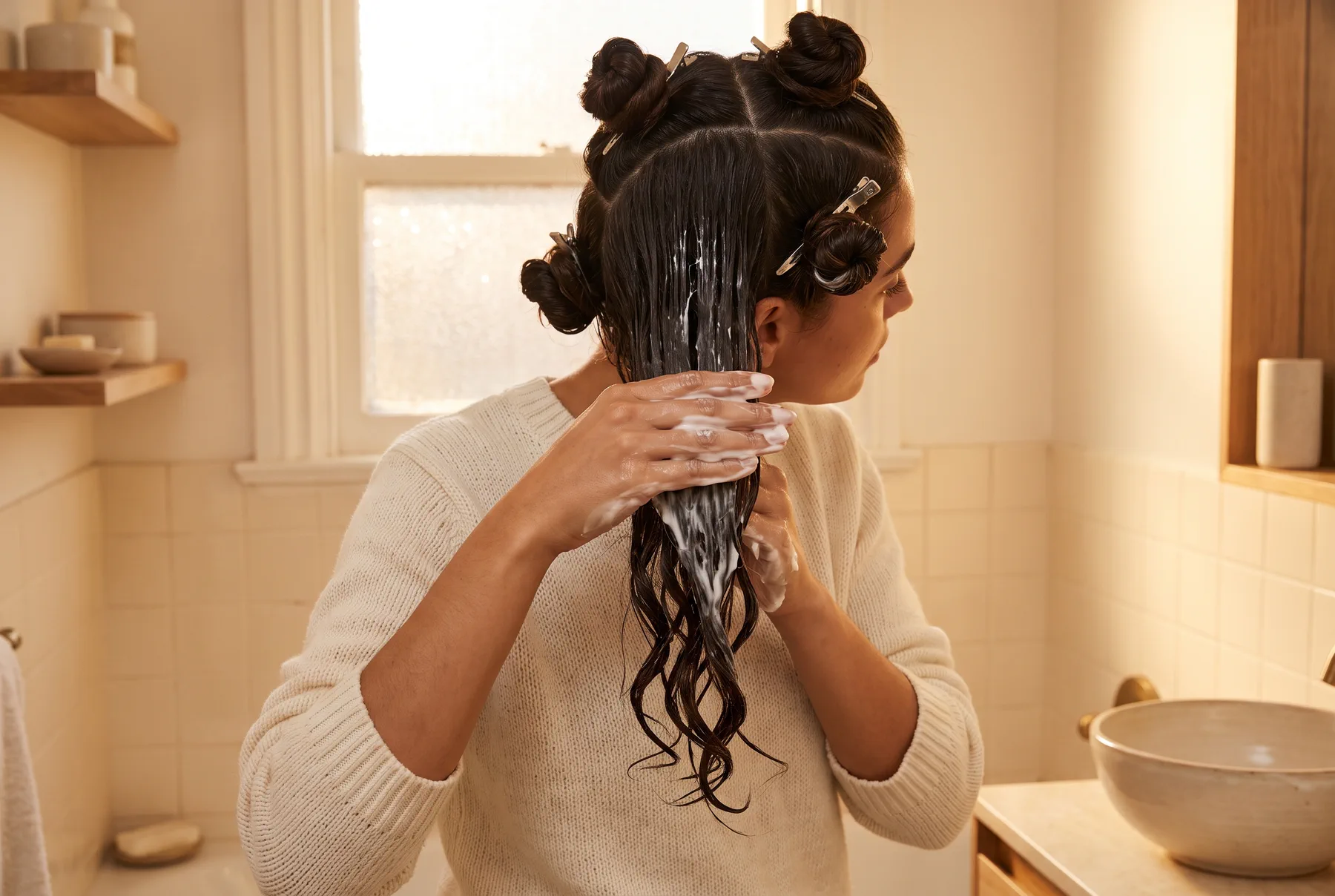
The goal is access, not a salon-perfect grid.
Short or lower-density hair may need only a few broad working areas. Long or high-density hair may need more sections so the spray reaches the interior. Fine strands can still be high density, so do not choose section count from strand thickness alone.
Use clips that hold without pulling. Release one working section at a time and keep the remaining hair out of the spray path.
Read How Hair Density Changes Product Amount and Sectioning for the full access guide.
Step 4: mist the mid-lengths and ends
Hold the bottle far enough away for the pump to create a light, distributed mist according to the package design. Focus on the mid-lengths and ends, where blow-dry brushes, iron plates and curling barrels usually travel.
Avoid spraying one point until it drips. Avoid unnecessary scalp saturation. Heat Shield is a leave-in styling preparation product, not a scalp treatment.
Apply to one section, then move to the next. A light pass through accessible sections produces better coverage than repeatedly spraying the outside of a closed mass of hair.
Step 5: distribute the product
A mist still needs distribution. Use your fingers, a suitable brush or a wide-tooth comb according to hair texture, condition and extension-care directions.
Start gently at the ends when detangling is needed, then work upward. Do not force a tool through knots. For curls and coils, use fingers or a compatible detangling method that preserves the pattern rather than brushing it apart by default.
After distribution, the section should feel lightly prepared, not soaked or sticky.
Step 6: let wet spray settle before direct heat
This step changes by tool.
Blow-dryer
Heat Shield is applied while hair is damp, so blow-drying can begin after even distribution. Use controlled airflow, keep the dryer moving and use the lowest effective heat.
Flat iron, curling iron or wand
The hair must be dry. If the mist created visible wetness, wait. Touch the section with clean fingers and confirm that it no longer feels damp before applying the hot tool.
Do not speed this step by pressing the iron onto wet spray.
Step 7: use controlled heat
Heat protectant is one part of the method. Four other variables remain:
- the tool setting;
- how long heat stays on the section;
- how many passes or repeated wraps the section receives;
- how often the style is repeated.
Use the lowest setting that produces the intended style with controlled technique. Test a hidden section before increasing heat. Stop once the section is dry or shaped.
There is no honest universal temperature for every person. Lightened ends, colour history, chemical straightening, breakage, strand diameter and tool calibration all change the response.
How much heat protectant spray should you use?
Use enough for even coverage without soaking the hair. There is no universal spray count because pump output, section size, length, density and texture differ.
You may need better coverage when
- only the outer layer received mist;
- interior sections feel untouched;
- one side was skipped;
- the product was sprayed into the air rather than onto the working section.
You may have used too much when
- one area is visibly wet on otherwise dry hair;
- the hair feels tacky, stiff or coated before styling;
- fine roots collapse even though the spray was intended for the lengths;
- the tool appears to drag because of excess product or buildup.
Do not solve uneven coverage by adding a heavy final coat. Divide the hair and distribute a lighter amount through each working area.
Applying Heat Shield before a blow-dry
- Shampoo and condition according to the hair's needs.
- Towel-blot until the hair is damp rather than dripping.
- Apply leave-in conditioner only when needed, using a controlled amount.
- Shake Heat Shield.
- Mist it evenly through sections, focusing on mid-lengths and ends.
- Distribute with fingers, a brush or a wide-tooth comb.
- Blow-dry with controlled airflow and the lowest effective heat.
- Keep the dryer moving and stop heating each area when it is dry.
Holding a dryer very close and still over one point increases local heat. A study of repeated drying on hair tresses found more surface damage as temperature increased and reported a lower-damage result when the dryer was kept about 15 centimetres away and moved continuously. That controlled test does not create a universal distance for every dryer, nozzle or hair type, but it supports avoiding stationary, close-range high heat.
Applying Heat Shield before a flat iron
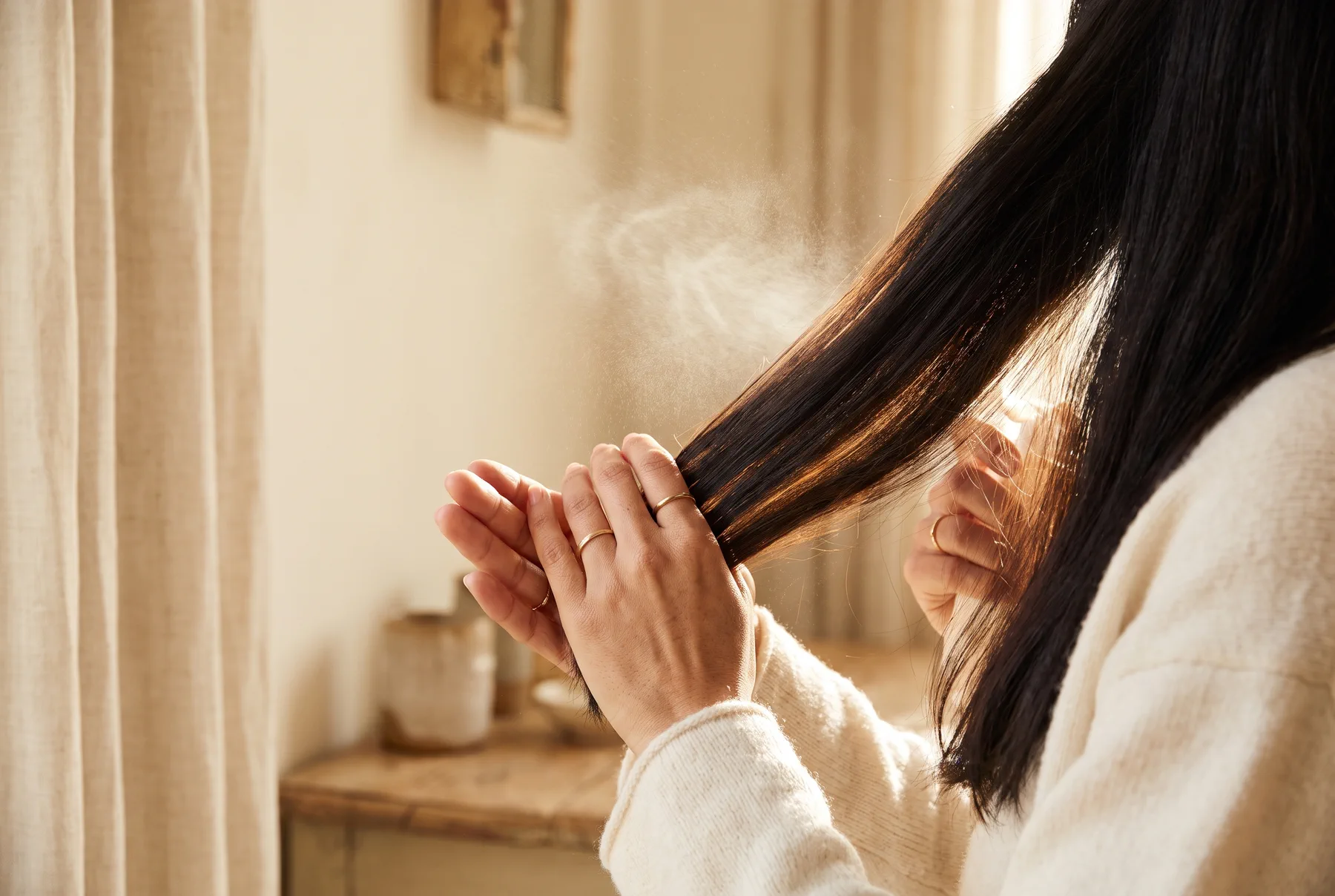
- Begin with clean, fully dry hair.
- Shake the bottle and create workable sections.
- Mist each section lightly through the lengths.
- Distribute the product evenly.
- Wait until the section is fully dry again.
- Test the lowest practical setting on a hidden section.
- Use a section size the plates can contact evenly.
- Make as few controlled passes as the style requires.
If a thick section requires repeated slow passes, divide it before increasing the temperature. If the tool drags, stop and check for buildup, wetness, damaged plates or too much product.
Applying Heat Shield before a curling iron or wand
- Work on dry hair.
- Apply and distribute Heat Shield before the section reaches the barrel.
- Let any dampness dry.
- Choose a section that wraps without forming a thick overlapping bundle.
- Keep the tool away from the scalp and skin.
- Release the curl after the shortest effective contact time.
- Let it cool before separating.
Repeatedly reheating a curl because it was disturbed while cooling creates avoidable exposure. Shape it once, let it set and reassess after it cools.
Applying Heat Shield before diffusing
Start with evenly damp waves, curls or coils. Apply the chosen curl leave-in or styler according to its directions. Add Heat Shield as the separate protection step only when the formulas and amounts have been confirmed to work together.
Mist through accessible sections without breaking apart the curl groups. Use controlled airflow and the lowest effective heat. Cup the hair gently rather than rubbing the diffuser through the pattern.
Stop when the section is dry. Reheating already-dry curls does not add moisture or protection.
Use Air-Dry vs Diffuse Curly Hair for the full drying decision.
Heat protectant and leave-in conditioner: which goes first?
On a damp-hair blow-dry routine, rinse-out conditioner comes out in the shower. A leave-in cream can follow on towel-blotted lengths when additional detangling or softness is needed. Heat Shield is then distributed before the heated tool.
Keep both applications light. Multi Complex Hair Cream and Heat Shield have different jobs, but layering too much of each can leave some hair coated.
Do not assume every leave-in conditioner includes heat protection. Look for a verified heat-protection claim and directions on the exact product.
For the complete order, read How to Layer Shampoo, Conditioner, Mask, Leave-In and Oil.
Should oil go before or after heat protectant?
Use an oil before heat only when that exact product has verified directions for pre-heat use. An ingredient name or oily texture does not prove thermal protection.
For a simple route, apply dedicated Heat Shield before the tool. After styling and cooling, use a measured finishing oil only where the dry ends need polish. Do not saturate and reheat the same section repeatedly.
Celine Claire Bonding Rosemary Oil has heat-care positioning for wet, damp or dry hair and separate exact-product directions. Moroccan Argan Oil has four measured methods, including a 1 to 2-drop dry finisher. Read the product page before combining either oil with Heat Shield.
Adjusting application by density and texture
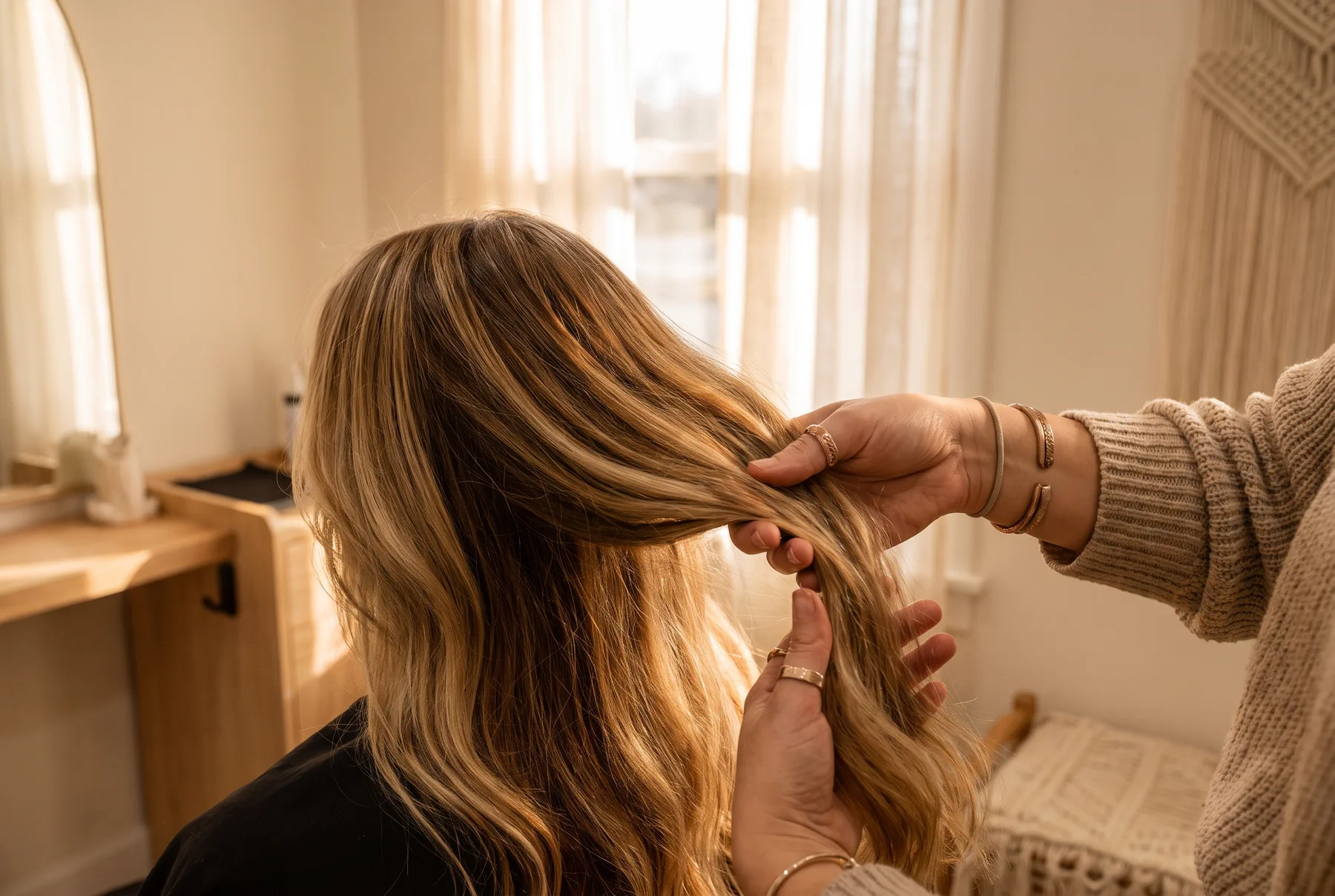
Fine or easily weighed-down hair
Use light section-by-section coverage, avoid the roots unless the label requires them and do not add extra spray for reassurance. Judge the finished movement.
High-density hair
Create more access points so the interior receives product. More sections often solve the problem before more total spray.
Curly and coily hair
Distribute without destroying the curl grouping. For a diffuser, work on damp hair. For a conventional iron or wand, the section must be dry.
Colour-treated, lightened or chemically processed hair
Use a conservative setting and fewer passes. Follow the stylist's waiting period and aftercare instructions. Unevenly processed lengths may respond differently from new growth.
Extensions
Apply lightly through the extension lengths only when the system permits it. Keep spray away from bonds, tapes, beads or attachment points unless the installer or manufacturer approves that placement.
Common application mistakes
Spraying only the top layer
The hair underneath receives no preparation. Use sections and work through them one at a time.
Soaking dry hair before an iron
More moisture is not more protection. Mist lightly, distribute and wait until the section is dry.
Treating Heat Shield like finishing hairspray
Heat Shield belongs before heated styling. It is not a firm-hold lacquer. Choose a separate finishing product when hold is the goal.
Using maximum heat because protectant was applied
The product does not cancel temperature, contact time or repeated passes. Use the lowest effective setting.
Guessing a protection temperature from the tool dial
The legacy Celine Claire page mentions that some tools may reach 230°C / 446°F. That does not prove Heat Shield protects to that temperature. Exact-product testing is required before a maximum badge can appear.
Reapplying before every pass
Repeatedly wetting and reheating one section can increase residue and exposure. Apply evenly before styling, then reduce passes through better section size and technique.
Ignoring dirty or damaged tools
Residue on plates and rough edges can make a tool drag. Clean and maintain it according to the manufacturer's instructions, unplugging and cooling it first.
How to know the application worked
The hair should be evenly prepared and able to move through the intended styling method without one wet, sticky or skipped area. After styling, assess:
- whether the tool moved smoothly;
- whether the interior and outer sections received comparable coverage;
- whether the roots retained the desired movement;
- whether the ends feel rougher after the session;
- whether fewer passes or a lower setting could create the same result next time.
Heat damage can accumulate even when the finished style looks smooth that day. Keep heat-free or lower-heat days in the routine where practical.
When to stop styling
Stop the tool if you smell burning, see smoke, hear unusual sizzling, feel scalp pain or notice the hair sticking to the plates. Unplug the tool and let it cool before inspecting it.
Reduce heat and seek appropriate advice when hair begins snapping, becomes unusually rough, feels gummy when wet or changes suddenly after a chemical service. Seek medical care for a burn, blistering or persistent scalp pain.
Frequently asked questions
Do I apply heat protectant to wet or dry hair?
Follow the exact product directions. Celine Claire Heat Shield is positioned for damp hair before blow-drying and dry hair before flat irons or curling tools.
Should heat protectant dry before straightening?
Yes. Hair must be dry before a conventional direct-contact flat iron touches it. Let any visible moisture from the spray dry completely.
How many sprays of heat protectant should I use?
There is no universal count. Pump output, length, density, section size and texture differ. Use enough for light, even coverage without soaking the hair.
Where should I apply Heat Shield?
Focus on the mid-lengths and ends where heated tools travel. Work through sections and avoid unnecessary scalp saturation.
Can I spray heat protectant on my roots?
Apply only where the product directions and styling path require it. For most Heat Shield use, the priority is even coverage through mid-lengths and ends. Excess root application may reduce movement or create buildup.
Can I use Heat Shield before blow-drying?
Yes. Apply it to clean, towel-blotted damp hair, distribute it through sections and blow-dry with controlled airflow and the lowest effective heat.
Can I use Heat Shield before a curling iron?
Yes. Apply it lightly to dry hair, distribute it and make sure the section is dry before wrapping it around the tool.
Does Heat Shield protect to 230°C or 446°F?
No precise limit should be promised from the current evidence. Exact-product thermal testing and approved claim wording are required first.
Can I use heat protectant every day?
Follow the label, but remember that product use does not make daily high heat harmless. Temperature, time, passes, frequency and hair condition still matter.
Can I use Heat Shield on extensions?
The current bottle positions it for extensions. Follow the installer and extension-system instructions, and avoid attachment points unless that placement is approved.
Is Heat Shield a hairspray?
It is a heat-protection preparation spray with anti-frizz, softness and shine positioning. It is not a firm-hold finishing hairspray.
Do I still need Heat Shield if I use Bonding Rosemary Oil?
They have overlapping heat-related positioning but different formats and roles. Heat Shield is the dedicated preparation spray. Bonding Rosemary Oil is concentrated leave-in care. Use the simplest compatible route and keep combined amounts controlled.