
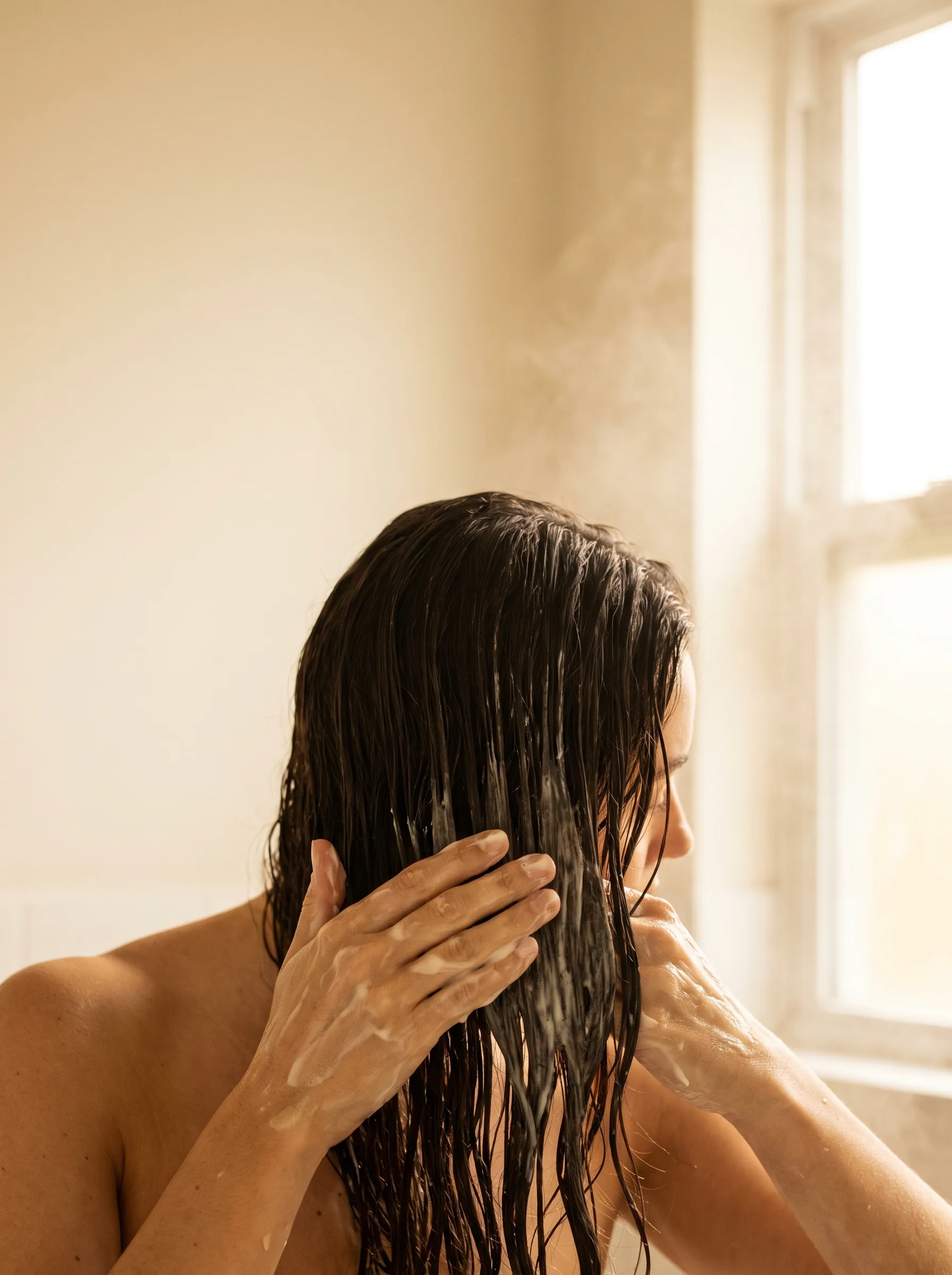
Shampoo and rinse, remove the amount of water specified by the product, apply the treatment where the hair needs it, follow the exact timer, rinse completely and continue only with the steps named in that product’s directions. More time and more product do not guarantee a better result.
What does deep conditioning do?
Deep conditioning aims to improve the physical and cosmetic behaviour of the hair fibre. Conditioning agents can deposit on or interact with the fibre, helping reduce friction between strands and improving slip, combing, softness, shine and manageability.
A 2023 review of hair-care physicochemistry explains that hair fibres consist of non-living cells and cannot biologically regenerate. Conditioners can temporarily cover or fill parts of a weathered surface and restore some physical properties. The hair may look and feel better, but a split or broken strand has not become untouched hair again.
Softer feel and easier detangling
Conditioning reduces friction between strands. Hair that moves past itself more easily is generally simpler to detangle and less likely to require forceful combing.
Smoother appearance and more shine
When the surface feels more even, light may reflect more consistently and the hair can look shinier. Results last according to the formula, washing, styling and hair condition rather than becoming permanent.
Better manageability after chemical or heat-related wear
Colouring, lightening, perming, straightening and repeated heat can leave lengths feeling dry or rough. The American Academy of Dermatology notes that colouring and perming can make hair dry and brittle and recommends careful aftercare. Conditioning supports feel and manageability; it cannot reverse every structural change caused by a service.
Reduced visible frizz through conditioning and technique
Improved slip and surface coating can make some frizz easier to manage. Humidity, natural texture, porosity, handling and styling technique still affect the finished result. Deep conditioning is one possible step, not a weatherproof guarantee.
Deep conditioner vs regular conditioner vs hair mask
Product names overlap. The clearest comparison comes from how the product is used.
| Product type | Main role | Rinse or leave in? | Celine Claire example |
|---|---|---|---|
| Regular conditioner | routine softness, slip and detangling | rinse out | Argan Oil Hydrating Conditioner, ~5 min |
| Conditioner-as-mask | richer method using the same conditioner | rinse out | Argan Oil Hydrating Conditioner, 10 min |
| Dedicated hair mask | concentrated treatment with its own method | rinse out; conditioner follows | Argan Oil Hair Mask, 2–3 min, then conditioner |
| Toning mask | temporary pigment plus conditioning | rinse out; replaces conditioner | Purple Mask, no more than 5 min |
| Leave-in conditioner | post-wash moisture, slip and styling support | leave in | Multi Complex Hair Cream |
| Professional smoothing | controlled service with technical protocol | product-specific | Nano Keratin Protein or Hair Botox |
Do not use “deep conditioning” as an umbrella term that makes these products interchangeable. A leave-in should not be rinsed out. A toning mask has pigment precautions. A professional smoothing treatment is not a weekly home mask.
How to tell whether your hair may need richer conditioning
One difficult wash day does not automatically require the richest product. Look for a repeated pattern.
The hair still feels rough after regular conditioner
If mid-lengths and ends remain difficult to detangle after the normal conditioning step, a richer route may help. First confirm that enough conditioner reached those areas and was distributed evenly.
Chemically processed lengths feel different from the roots
Lightened, coloured, permed or straightened lengths may need different placement from new growth. Concentrate richer care where the hair feels dry or rough instead of coating every root by default.
The ends look dull or catch against one another
Older ends have experienced more washing, weather and styling. A mask may improve lubrication and appearance. Trim splits when needed — a cosmetic treatment cannot fuse them permanently.
Frizz appears before styling begins
When hair is rough and tangled as soon as the towel comes off, the wash-day foundation may be incomplete. When frizz appears only during curl setting or hot-tool styling, a leave-in, curl product or heat-protection adjustment may be more relevant than another mask — see the frizzy hair treatment guide.
The hair is already soft but becomes flat or coated
This usually argues for less product, lighter placement or less frequent rich treatment. Fine and easily weighed-down hair can still use conditioning, but the amount and location matter.
How to deep condition hair correctly
These steps are a decision framework. The package directions remain the final authority.
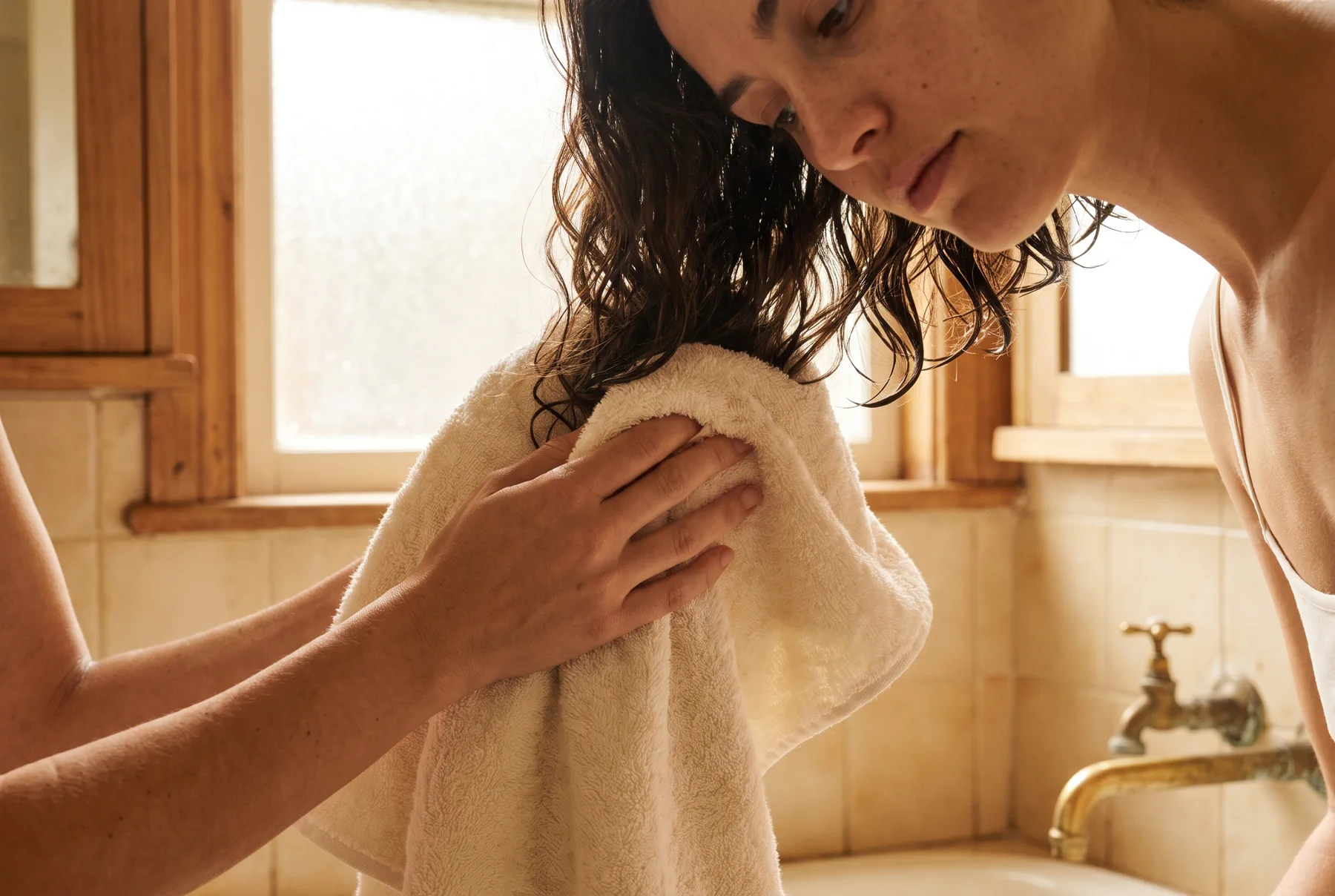
Choose one treatment path
Decide whether the wash day needs regular conditioner, the conditioner’s longer mask method, a dedicated hair mask or a toning mask. Do not begin by stacking all four.
Shampoo, rinse, manage water
Apply shampoo according to its own directions, focusing cleansing where oil and buildup collect. Rinse until no obvious lather remains. Some products go on wet hair; Argan Oil Hair Mask specifically goes on freshly washed, towel-dried hair. Follow the exact instruction.
Apply by section · use the exact timer
Work through areas that need care. Dry or weathered mid-lengths and ends may need more attention than roots. Set a timer when the direction gives one — do not extend the processing time because the hair feels dry. Celine Claire methods range from 2–3 minutes for the dedicated Argan Oil Hair Mask to 10 minutes for the Argan Oil Hydrating Conditioner mask method.
Rinse, follow order, judge dry
Rinse thoroughly — incomplete rinsing leaves hair heavy or coated. The Argan Oil Hair Mask is rinsed and followed with conditioner; the Purple Mask replaces the separate conditioner on that wash day; a leave-in comes after all rinse-out steps. Wet hair can feel slippery even when the amount is too rich — assess softness, movement, root weight and coating after the hair dries.
Celine Claire deep-conditioning routes
Route 1: regular conditioning with an optional richer method
Use Argan Oil Hydrating Conditioner after shampooing when the main goals are softness, detangling, moisture and manageable movement.
Regular method: shampoo → rinse → remove excess water → coat the hair → leave approximately 5 minutes → rinse thoroughly.
Conditioner-as-mask method: apply after shampooing → leave 10 minutes → rinse thoroughly.
Choose one timing. Do not use the 5-minute method and then repeat the same product for another 10 minutes.
Route 2: the dedicated Argan Oil Hair Mask
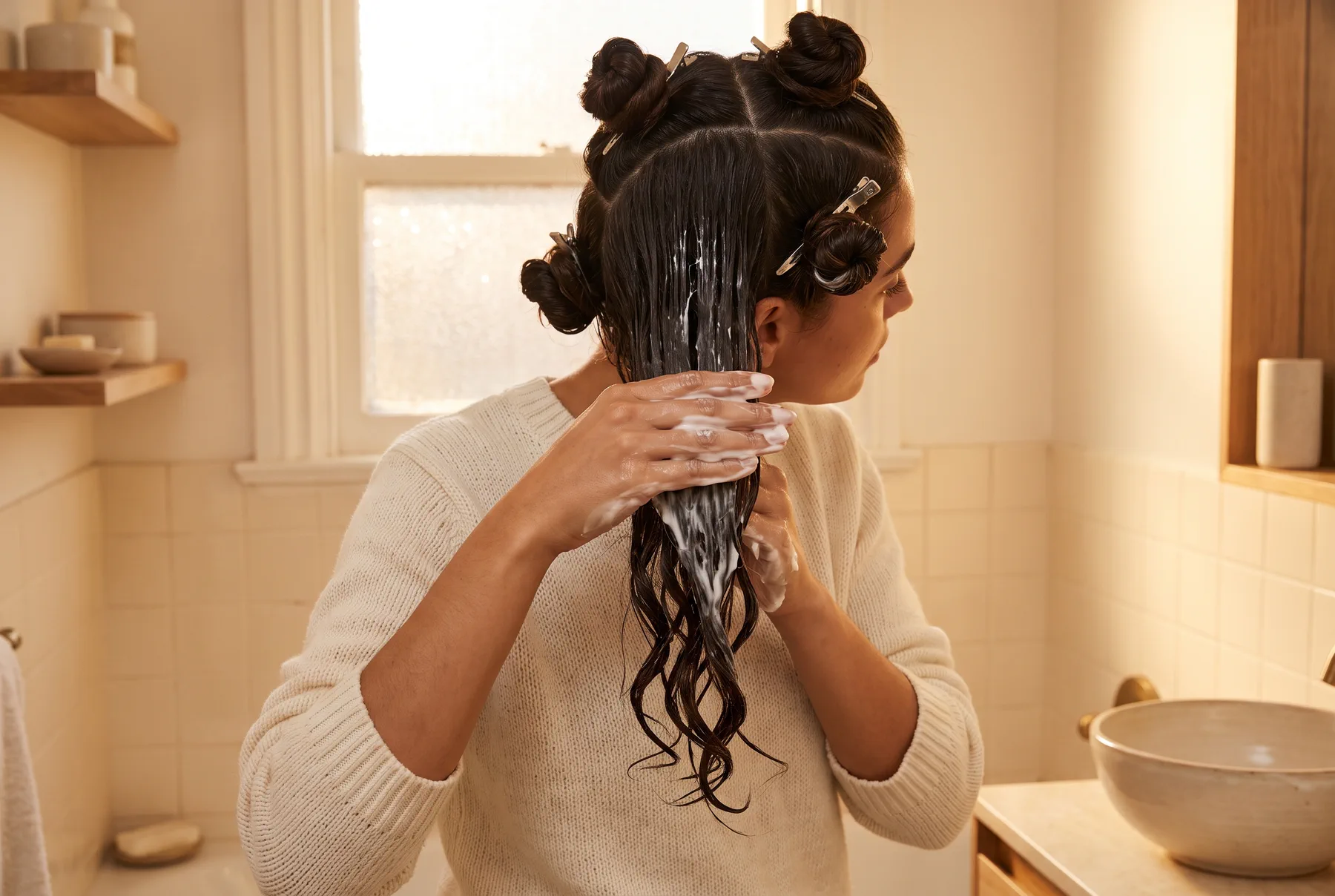
Use Argan Oil Hair Mask when the routine needs a separate rich rinse-out treatment for dry, rough, frizzy or styling-worn lengths.
- Shampoo and rinse thoroughly.
- Towel-dry so the hair is damp rather than dripping.
- Apply the mask through the hair, focusing on dry or damaged-looking mid-lengths and ends.
- Leave it for 2–3 minutes.
- Rinse thoroughly.
- Follow with a Celine Claire Conditioner.
Use it as needed. Older 5-, 10- or 10–15-minute alternatives are superseded by this direction.
Route 3: conditioner as the richer step
Some customers do not need a separate mask. The 10-minute method of Argan Oil Hydrating Conditioner can serve as the richer route on that wash day. Especially useful when the hair responds well to the conditioner and another product would add unnecessary weight. Do not combine this route with the dedicated Hair Mask automatically — choose between them.
Route 4: toning plus conditioning for blonde or silver hair
Purple Mask for Blonde Hair combines temporary violet pigment with rinse-out conditioning. It is for blonde, platinum, silver, grey or highlighted hair showing unwanted yellow or brassy-looking warmth.
- Shampoo and rinse.
- Skip separate conditioner.
- Protect hands and surfaces from pigment.
- Apply the mask evenly to wet hair.
- Leave for no more than 5 minutes.
- Rinse thoroughly.
Very pale or porous sections may take pigment faster — begin conservatively and judge the dry result before the next use. Full context in the colour-treated hair guide.
Route 5: leave-in care after rinse-out conditioning
Multi Complex Hair Cream is not a deep conditioner. It is a no-rinse cream used after washing when the hair still needs detangling, softness or visible frizz support. Apply a small amount to towel-blotted mid-lengths and ends, detangle from the ends upward and leave it in. Fine hair should begin with less. Use Heat Shield Hair Spray separately before heated tools — the cream is not the dedicated heat-protection step.
Does every dry-hair problem need protein?
No. Dryness and protein-related product selection are not the same decision.
Hydrolyzed proteins and amino acids can be used as conditioning agents. A review in Dermatology Practical & Conceptual describes their temporary contributions to strength, hydrophobicity and surface coating. The result depends on the ingredient, molecular size, formula and hair condition.
Hair that feels stiff, rough or brittle after a protein-rich product may need a different formula or less frequent use. Do not diagnose “protein overload” from one symptom alone, and do not assume every damaged-looking strand needs the strongest protein treatment.
Nano Keratin Protein and Hair Botox belong to advanced smoothing or protocol-controlled treatment categories. They are not substitutes for an ordinary hair mask. Nano Keratin Protein is marked Professional Use Only and requires the exact Celine Claire protocol, safety information, ventilation and trained handling.
Deep conditioning for different hair needs
Fine or easily weighed-down hair
Begin with less product and focus on the lengths and ends. The 10-minute conditioner method may be enough without a separate dedicated mask. If dry hair loses movement after treatment, reduce the amount or frequency.
Thick, dense, curly or coily hair
Work in sections so the treatment reaches the interior rather than coating only the surface. Add product where sections still lack slip instead of applying one large dose at once.
Colour-treated or lightened hair
Choose conditioning that fits the service and current aftercare instructions. Purple Mask is relevant only when temporary violet toning is also wanted — it is not a general mask for every colour.
Oily roots with dry ends
Concentrate rich product where the hair feels dry. Rinse completely and reduce root application if the finished hair becomes heavy. A dry end does not require coating the scalp.
Heat-styled hair
Conditioning can support feel and manageability, but it does not replace heat protection. Apply Heat Shield Hair Spray before blow-dryers, flat irons or curling tools and use the lowest effective setting. See Best Treatment for Dry Hair for the full routine framework.
Eight deep-conditioning mistakes
- Leaving every mask on for 30 minutes. Timing comes from the product. The Argan Oil Hair Mask needs 2–3 minutes under its current directions.
- Assuming longer means deeper. Once the labelled time has passed, extra minutes may add inconvenience, weight or pigment uptake without a proven benefit.
- Combining both mask paths. Choose the dedicated Argan Oil Hair Mask or the 10-minute conditioner-as-mask method — not both.
- Treating leave-in conditioner as a mask. Multi Complex Hair Cream stays in the hair after washing; it does not belong under a shower cap and should not be rinsed like a deep conditioner.
- Applying added heat without instructions. A steamer or heat cap changes the process. Use added heat only when the exact product directions and safety information call for it.
- Ignoring pigment in a toning mask. Purple Mask has a 5-minute current maximum and staining precautions. Porous or very pale sections may pick up pigment faster.
- Using professional smoothing treatment as weekly care. Nano Keratin Protein and Hair Botox have separate protocol and safety requirements — not richer versions of a rinse-out conditioner.
- Judging only while the hair is wet. Wait for the hair to dry. Movement, root weight, curl pattern and coating are easier to assess then.

A one-variable wash-day tracker
Record the result instead of guessing.
| Wash date | Product & exact method | Placement | Dry result | Next adjustment |
|---|---|---|---|---|
| Example | Argan Conditioner, 10 min | mid-lengths and ends | soft but slightly flat | use less next time |
| Your wash | — | — | — | — |
| Your wash | — | — | — | — |
Change only one item per wash: product, amount, placement, timing or frequency. A simple record makes it easier to find the point where the hair feels conditioned without becoming coated.
Rich rinse-out treatment for dry, rough, frizzy or styling-worn lengths. Applied to freshly washed, towel-dried hair for 2–3 minutes, rinsed thoroughly, then followed with a Celine Claire Conditioner. Use as needed rather than on every wash day.
Frequently asked questions
What is deep conditioning?
Deep conditioning is a richer rinse-out care step designed to improve softness, slip, manageability and surface feel when regular conditioning is not enough. Product names vary, so the exact label determines application, timing, rinsing and whether another conditioner follows.
What is the difference between conditioner and deep conditioner?
Regular conditioner is usually the routine post-shampoo step. A deep conditioner or mask is generally richer or has a different method. Argan Oil Hydrating Conditioner also has its own 10-minute mask method, showing why product directions matter more than the category name.
Is a hair mask the same as deep conditioning?
A rinse-out hair mask can be a deep-conditioning product, but not every mask has the same job. Purple Mask adds temporary violet pigment, while Argan Oil Hair Mask focuses on rich conditioning. Compare purpose, placement and timing before treating them as interchangeable.
How often should I deep condition my hair?
Follow the exact product directions and adjust from the dry result. Hair that becomes coated or flat may need less product or less frequent use. Argan Oil Hair Mask currently says use as needed rather than imposing one weekly schedule.
How long should I leave a deep conditioner on?
Use the label time. Argan Oil Hair Mask is currently 2–3 minutes, its Hydrating Conditioner mask method is 10 minutes, and Purple Mask is no more than 5 minutes. Never replace these with a universal 20- or 30-minute rule.
Should I deep condition before or after shampoo?
The Celine Claire routes in this guide come after shampooing and rinsing. Argan Oil Hair Mask goes on freshly washed, towel-dried hair. Other brands may use a pre-shampoo method, so follow the directions for the exact product in your hand.
Do I use regular conditioner after a hair mask?
It depends on the mask. Argan Oil Hair Mask is rinsed and followed with a Celine Claire Conditioner. Purple Mask currently replaces the separate conditioner on that wash day. Do not generalize one order to every mask.
Can fine hair use a deep conditioner?
Yes, but start with a smaller amount, focus on the lengths and rinse thoroughly. If the dry result is flat, coated or oily-looking, reduce the amount, placement or frequency rather than assuming the hair cannot use conditioning at all.
Can I deep condition oily hair?
Oily roots and dry ends can exist together. Apply richer care mainly where the hair needs it, use less near the roots and rinse completely. Choose cleansing frequency according to the scalp rather than trying to solve root oil with a heavy mask.
Can deep conditioning help colour-treated hair?
Conditioning can support softness, manageability and appearance after colouring or lightening. Follow the aftercare for the specific service. Choose Purple Mask only when temporary violet toning is wanted, and use conservative timing on pale or porous sections.
Does deep conditioning permanently repair damaged hair?
No. Conditioners can coat, lubricate and temporarily improve parts of a weathered hair surface. Hair fibres do not biologically regenerate, and a split or broken end is not permanently restored by a cosmetic mask.
Should I use heat with a deep conditioner?
Only when the exact product instructions explicitly require it. Do not add a steamer, heated cap or hot towel to Celine Claire methods in this guide. More heat is not a universal shortcut to better conditioning.
Can I make a deep conditioner at home?
Kitchen mixtures do not come with the stability, preservation, pH, compatibility and safety controls of a finished cosmetic formula. Oils, foods or botanical ingredients can cause buildup or irritation. A product with clear directions is the more predictable choice.
Is leave-in conditioner a deep conditioner?
No. Leave-in conditioner remains on the hair after washing. Multi Complex Hair Cream supports detangling, softness and styling without a second rinse. A deep conditioner or mask is normally rinsed according to its own timer.
When should I stop using a treatment?
Stop if the scalp or skin develops burning, swelling, significant itching or another concerning reaction. Rinse thoroughly and seek appropriate medical advice when symptoms are severe or persistent. Review the current ingredient list before use if you have known sensitivities.
Sources
- Fernandes C et al., “On Hair Care Physicochemistry: From Structure and Degradation to Novel Biobased Conditioning Agents,” 2023. pmc.ncbi.nlm.nih.gov/PMC9921463
- D’Souza P, Rathi SK, “Shampoo and Conditioners: What a Dermatologist Should Know?” 2015. pmc.ncbi.nlm.nih.gov/PMC4458934
- Gavazzoni Dias MFR et al., “Hair Cosmetics for the Hair Loss Patient,” 2021. pmc.ncbi.nlm.nih.gov/PMC8719955
- American Academy of Dermatology, “How to stop damaging your hair.” aad.org
- American Academy of Dermatology, “Coloring and perming tips for healthier-looking hair.” aad.org