

Product format decides placement. Scalp-labelled formula → follow its exact scalp directions. Hair oil or finisher → apply where its label directs, usually the lengths and ends. Essential-oil concentrate → do not apply directly and do not create an improvised DIY cosmetic.
First, identify which kind of rosemary oil you have
The words on the front of a bottle do not provide enough information. Turn the product around and read its directions, warnings and ingredient list.
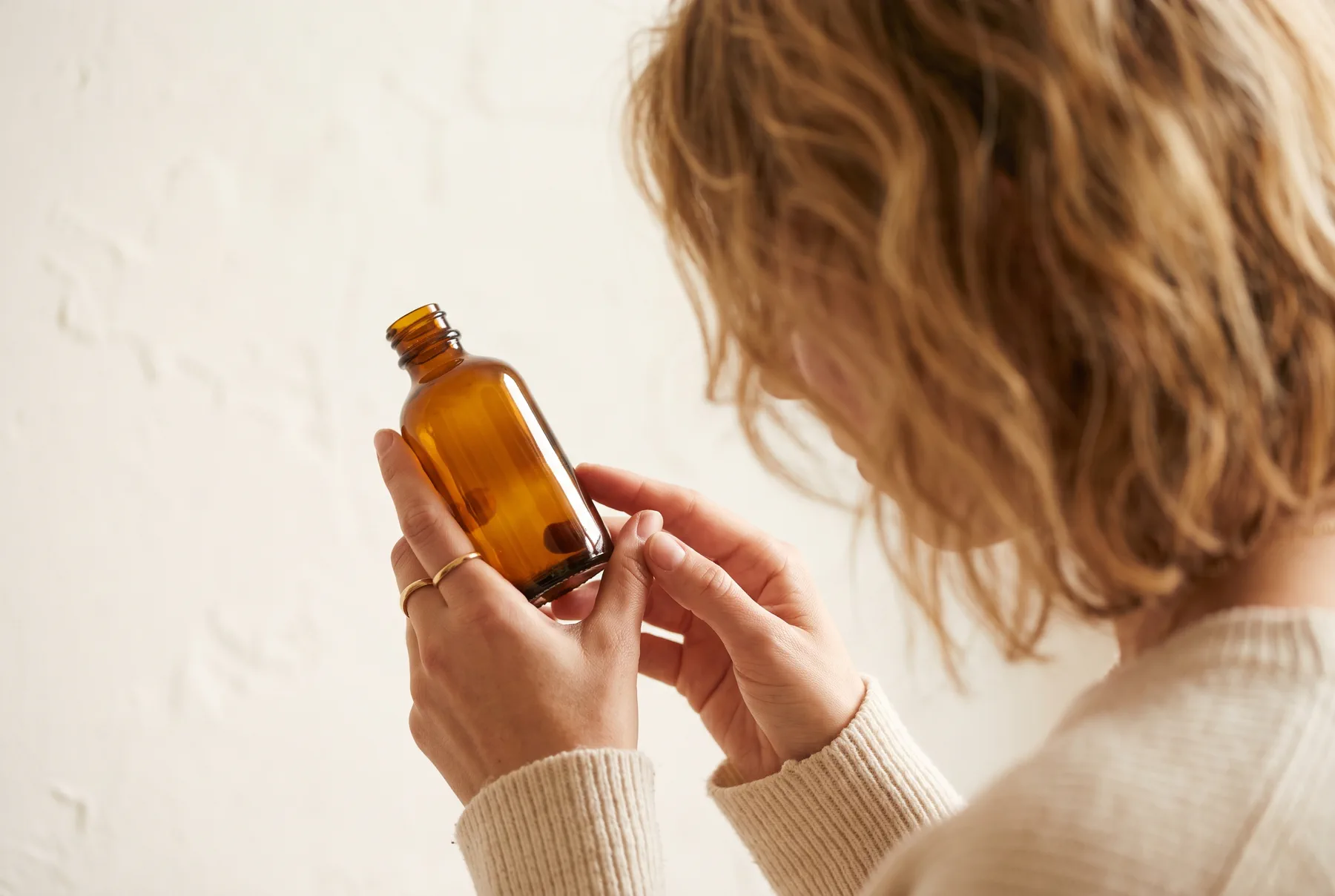
1. Concentrated rosemary essential oil
This is a concentrated aromatic plant extract, often sold in a small bottle for fragrance or aromatherapy use. It is not automatically a finished scalp cosmetic. Do not apply it directly to the scalp and do not guess at a home dilution.
Health Canada notes that essential oils may be sold at concentrations up to 100% and used in homemade applications. It also states that “natural” does not always mean safe and that it does not recommend or approve DIY uses. The practical choice is a properly formulated product with directions for the intended area.
2. A ready-to-use rosemary scalp product
This is a complete formula whose label specifically permits scalp application. It may be a pre-shampoo oil, leave-in serum or another scalp format. The label determines whether it stays on, rinses out, belongs on dry or damp scalp and how often it is used.
Do not assume that every ready-to-use scalp product can be left overnight. Contact time varies by formula.
3. A rosemary hair oil, bonding oil or finisher
This format is intended to improve the feel and appearance of the hair fibre. Its role may include manageability, softness, shine, frizz control, heat-styling support or care for dry-looking ends. Unless the label also names the scalp, apply it to the hair where directed.
Celine Claire Bonding Rosemary Oil belongs in this group. Its current method is through wet, damp or dry hair, especially the lengths and ends.
Scalp or hair? Use this placement check
| What the package says | Where to apply it | What not to assume |
|---|---|---|
Rosemary essential oil, concentrated aromatic oil or no hair/scalp directions | Do not apply directly; use only as legally labelled | Do not invent a scalp dilution or add it to another cosmetic |
Scalp oil, scalp serum or explicit scalp directions | Apply only as the current label instructs | Do not extend the contact time or leave it overnight without permission |
Pre-shampoo treatment | Use before cleansing for the stated contact time, then rinse or shampoo as directed | Do not convert it into a leave-in |
Leave-in scalp serum | Apply to the scalp using the labelled amount and frequency | Do not rinse unless directed |
Hair oil, finishing oil, bonding oil or lengths-and-ends directions | Apply to the hair, commonly mid-lengths and ends | Do not infer scalp use from the word rosemary |
Shampoo, conditioner or mask containing rosemary | Use as that product category directs | Do not treat it like pure rosemary oil |
If the directions are missing, unclear or unreadable, pause. Contact the manufacturer rather than copying a method from a different bottle online.
How to apply a ready-to-use rosemary scalp product
This section applies only to a finished product whose current label explicitly authorizes scalp use. It does not apply to Celine Claire Bonding Rosemary Oil.
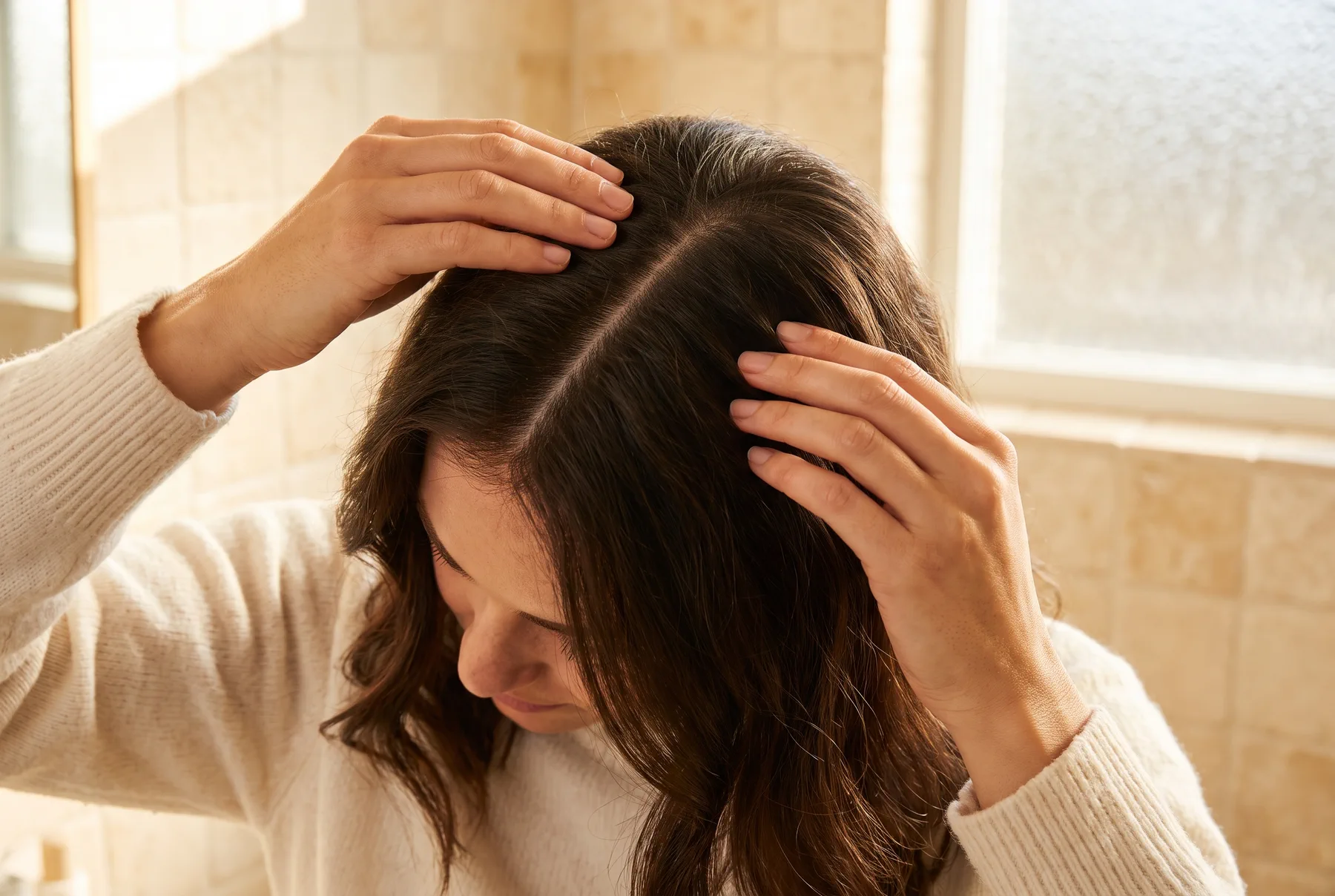
Read the label · expose in sections
Confirm whether the scalp should be dry or damp, whether the product is pre-shampoo or leave-in, the stated amount, contact time, frequency and all warnings.
Part the hair so the applicator can reach the intended scalp area without coating all the lengths. Sectioning also makes it easier to avoid repeatedly dosing the same spot.
Labelled amount · distribute as directed
More is not automatically better. Use the dispenser as designed and follow the package amount. Do not add concentrated essential oil to “strengthen” the formula.
If the product says to massage it in, use gentle fingertip contact and follow the stated time. Do not scratch with nails or use aggressive friction on an irritated scalp.
Observe the stated contact time
Rinse-out, pre-shampoo and leave-in products have different rules. A 20-minute treatment cannot automatically become an overnight application. A leave-in cannot automatically be rinsed after a few minutes and expected to perform the same way.
Stop if a reaction develops
Health Canada notes that cosmetics can sometimes cause allergic reactions and skin irritation. Stop using the product if it causes burning, significant itching, swelling, blistering or a persistent rash. Seek medical advice when a reaction is significant or does not settle.
How to apply rosemary oil to the hair lengths and ends
Use this route for a finished hair oil or styling product whose label directs application to the hair.

- Choose wet, damp or dry hair according to the package. Do not assume every oil works at every stage.
- Begin with a small amount. Fine, short or easily weighed-down hair should start especially lightly.
- Spread the formula between both palms. This helps prevent one saturated patch.
- Start at the ends. Move upward through the mid-lengths only where needed.
- Distribute for the hair’s texture and density. Dense, curly or coily hair may be easier to cover in sections.
- Follow the rinse or leave-in direction. A finishing oil normally stays in; a pre-shampoo treatment does not necessarily stay in.
The visible finish is useful feedback. If the roots look flat or the strands separate into oily sections, the amount or placement may have been too heavy. If dense inner sections remain untouched, divide the hair rather than pouring more over the surface.
How to apply Celine Claire Bonding Rosemary Oil
Celine Claire Bonding Rosemary Oil, also identified on its package as Tec Plex 7 Bonding Oil, is not a generic scalp-oiling product. It is a concentrated leave-in bonding, styling and finishing oil for wet, damp or dry hair.
Detangling & styling prep
- Gently remove excess water.
- Dispense a small controlled amount into the palm.
- Rub both hands together.
- Work through the lengths and ends.
- Distribute evenly, adding only if needed.
- Leave it in and style as desired.
Use for detangling, manageability, frizz control, softness, shine or heat-styling preparation. Heat protection is part of the product positioning; no maximum temperature should be assumed without approved testing.
Measured polish only
Use less than you would on wet hair. Spread a trace over the hands, touch the ends first, then skim the remaining product over selected frizz or flyaways. Stop when the finish looks polished rather than coated.
Targeted refresh, not a reapplication
Target only dry-looking ends or areas that need a light polish. Do not automatically reapply through the entire head. If the hair already feels coated, cleansing may be more useful than adding another layer.
Not a scalp treatment
Do not convert this bottle into an overnight scalp oil, a pre-shampoo scalp saturation ritual or a rinse-out mask. The rosemary in the name does not change the finished formula’s directions.
For the expanded single-product method, read How to Use Bonding Rosemary Oil.
Why the rosemary ingredient story does not replace directions
The current Celine Claire product story associates rosemary with scalp stimulation, circulation, healthy hair growth, fullness, volume and hair-regrowth benefits. That established positioning remains part of the product story. The correct application still comes from the finished formula’s directions.
A product can contain an ingredient discussed in scalp research while being formulated and directed for the hair lengths. Moving it to a different body area, increasing exposure or changing a leave-in into an overnight treatment creates a new use that the product directions may not support.
This rule also works in reverse. A pre-shampoo scalp oil should not be presented as a heat-protective styling oil unless its own label supports that use.
What does research say about rosemary oil and hair?
One frequently cited randomized comparative trial was published in 2015. It assigned 100 people with androgenetic alopecia to a rosemary-oil preparation or 2% minoxidil for six months. The researchers reported no significant change in mean hair count for either group at three months. Both groups showed an increase from baseline at six months, with no significant difference in hair count between them. Scalp itching increased in both groups and was more frequent in the minoxidil group.
That study is worth understanding, but it has firm limits:
- it examined a specific preparation and study population;
- it did not test every product containing rosemary;
- it did not test Celine Claire Bonding Rosemary Oil;
- it does not make all DIY recipes equivalent;
- it does not establish guaranteed regrowth for every cause of hair loss;
- it does not replace diagnosis or approved treatment advice.
Sudden shedding, smooth bald patches, scalp pain, sores or progressive thinning deserve assessment by a qualified healthcare professional. An article cannot identify the cause from appearance alone.
Wet scalp, dry scalp, wet hair or dry hair?
There is no single answer for all rosemary products.
| Product format | Wet or dry? | Governing instruction |
|---|---|---|
| Ready-to-use scalp oil | Whatever its label specifies | Current package directions |
| Leave-in scalp serum | Whatever its label specifies | Current package directions |
| Pre-shampoo scalp treatment | Often before cleansing, but do not generalize | Current package directions |
| Shampoo containing rosemary | Wet hair and scalp as shampoo directs | Shampoo directions |
| Conditioner or mask containing rosemary | Usually after cleansing on the directed areas | Conditioner or mask directions |
| Celine Claire Bonding Rosemary Oil | Wet, damp or dry hair | Small amount through lengths and ends; leave in |
The reliable rule is not “all scalp oil goes on dry hair” or “all rosemary oil goes on a clean scalp.” The reliable rule is to match the method to the specific finished formula.
Seven mistakes to avoid
- Applying concentrated essential oil directly to the scalp. An essential-oil concentrate is not automatically a finished topical product. Direct exposure may irritate or sensitize skin.
- Using an online dilution recipe as a substitute for a formulated product. Home recipes rarely account for the concentrate, exposure, stability, contamination or the complete condition of the user’s scalp. Health Canada does not recommend or approve DIY essential-oil uses.
- Adding essential oil to a bottle of shampoo or conditioner. This changes a finished cosmetic without confirming preservation, uniform distribution or exposure. Use a product already formulated with rosemary instead.
- Leaving every scalp oil on overnight. Contact time is product-specific. Longer exposure is not automatically more effective and may increase discomfort or buildup.
- Applying a hair finisher to the scalp because the front label says rosemary. Read the use directions, not only the hero ingredient. Bonding Rosemary Oil belongs on wet, damp or dry hair, especially lengths and ends.
- Ignoring itching or burning because the product is natural. Natural ingredients can still irritate skin or trigger allergic contact dermatitis. Stop using a product that produces a concerning reaction.
- Treating all hair loss as one condition. Hair shedding and thinning have many possible causes. Rosemary content should not delay professional assessment when the change is sudden, patchy, painful or persistent.
A label-reading checklist before applying rosemary oil
- What is the full product name?
- Is it a concentrated essential oil or a finished cosmetic?
- Does the label explicitly name the scalp, hair or both?
- Is it pre-shampoo, rinse-out or leave-in?
- Does it specify wet, damp or dry use?
- What amount and frequency does it state?
- Does it require a patch test?
- Are there eye-contact, age, pregnancy or other warnings on the package?
- Is the bottle and label current and legible?
- Am I copying instructions from a different product?
If the answer is unclear, contact the manufacturer before use.
A 90 ml leave-in bonding, styling and finishing oil for the lengths and ends of wet, damp or dry hair. Never a scalp oil, overnight treatment or rinse-out mask — the rosemary in the name does not change the finished formula’s directions.
Frequently asked questions
Can rosemary oil be applied directly to the scalp?
A finished rosemary scalp product may be applied as its label directs. Concentrated rosemary essential oil should not be applied directly, and Celine Claire Bonding Rosemary Oil should be used through the hair lengths and ends rather than converted into a scalp treatment.
Should rosemary oil go on the scalp or the hair?
It depends on the product. Scalp oils and scalp serums belong where their labels direct. Styling, bonding and finishing oils often belong on the lengths and ends. The word rosemary alone does not determine placement.
Can I mix rosemary essential oil into shampoo?
Do not alter a finished shampoo with an improvised essential-oil addition. It may change exposure, stability and how evenly the concentrate is distributed. Choose a shampoo already formulated with rosemary and follow its directions.
Do I need to dilute rosemary essential oil?
Do not apply a concentrate directly. Rather than relying on an online DIY ratio, choose a properly formulated scalp or hair product with complete directions. Health Canada does not recommend or approve DIY essential-oil uses.
Can rosemary oil stay on the scalp overnight?
Only when the exact finished product explicitly permits overnight scalp use. Do not extend a pre-shampoo contact time on your own. Celine Claire Bonding Rosemary Oil is a leave-in hair product, but it is not an overnight scalp treatment.
Is rosemary oil better on wet or dry hair?
The formula decides. Celine Claire Bonding Rosemary Oil may be used on wet, damp or dry hair. Another rosemary product may specify only a dry scalp, a pre-shampoo application or use during cleansing.
How much rosemary oil should I apply?
Use the amount stated by the exact product. For Celine Claire Bonding Rosemary Oil, begin with a small controlled amount, distribute it through the lengths and ends, then add only if the hair still needs it.
How often should I use rosemary oil?
Frequency depends on whether the product is a shampoo, scalp treatment, serum or finishing oil. Follow its current label and observe how the scalp or hair responds. There is no responsible universal schedule for every rosemary formula.
Should I wash rosemary oil out?
Wash it out only when the product is labelled as a rinse-out or pre-shampoo treatment. Leave-in formulas remain in as directed. Celine Claire Bonding Rosemary Oil is a leave-in hair product.
Can rosemary oil cause an itchy scalp?
Yes, a cosmetic or essential-oil product can irritate skin or trigger an allergic reaction. The 2015 rosemary study also reported increased scalp itching during the trial. Stop using a product if it causes a concerning reaction and seek medical advice when symptoms are significant or persistent.
Does rosemary oil regrow hair?
Research includes one six-month comparative trial in androgenetic alopecia, but it did not test every formula or every cause of hair loss. Celine Claire retains its established rosemary hair-regrowth, healthy-growth, fullness and volume positioning without promising a guaranteed result or medical treatment.
Can I use rosemary oil if I have dandruff or an irritated scalp?
Dandruff-like flaking and irritation can have different causes. Do not apply a new oil to broken, painful or actively reacting skin without appropriate advice. A board-certified dermatologist or qualified clinician can help identify persistent scalp symptoms.
Is Celine Claire Bonding Rosemary Oil a scalp oil?
No. It is a leave-in bonding, styling and finishing oil. Apply a small amount through wet, damp or dry hair, primarily the lengths and ends, then style as desired.
Is Bonding Rosemary Oil the same as pure rosemary essential oil?
No. It is a complete 90 ml haircare formula with its own directions. Essential-oil advice should not replace the package instructions for the finished product.
Can I use Celine Claire Bonding Rosemary Oil before heat styling?
Yes, heat protection is part of the current product positioning. Apply it through wet or damp lengths before styling and use controlled heat.
What should I do if the product directions online and on my bottle differ?
Pause and contact Celine Claire with photographs of the bottle and batch details. Do not combine two versions of the instructions. The current production label and approved product record should determine use.
Sources
- Health Canada, “Essential oils and botanical extracts.” canada.ca
- Health Canada, “Use cosmetics safely.” canada.ca
- American Academy of Dermatology, “Contact dermatitis: signs and symptoms.” aad.org
- American Academy of Dermatology, “How to relieve an itchy scalp.” aad.org
- Panahi Y et al., “Rosemary oil vs 2% minoxidil solution for the treatment of androgenetic alopecia: a randomized comparative trial,” 2015. pubmed.ncbi.nlm.nih.gov/25842469 — research context, not Celine Claire product proof.