
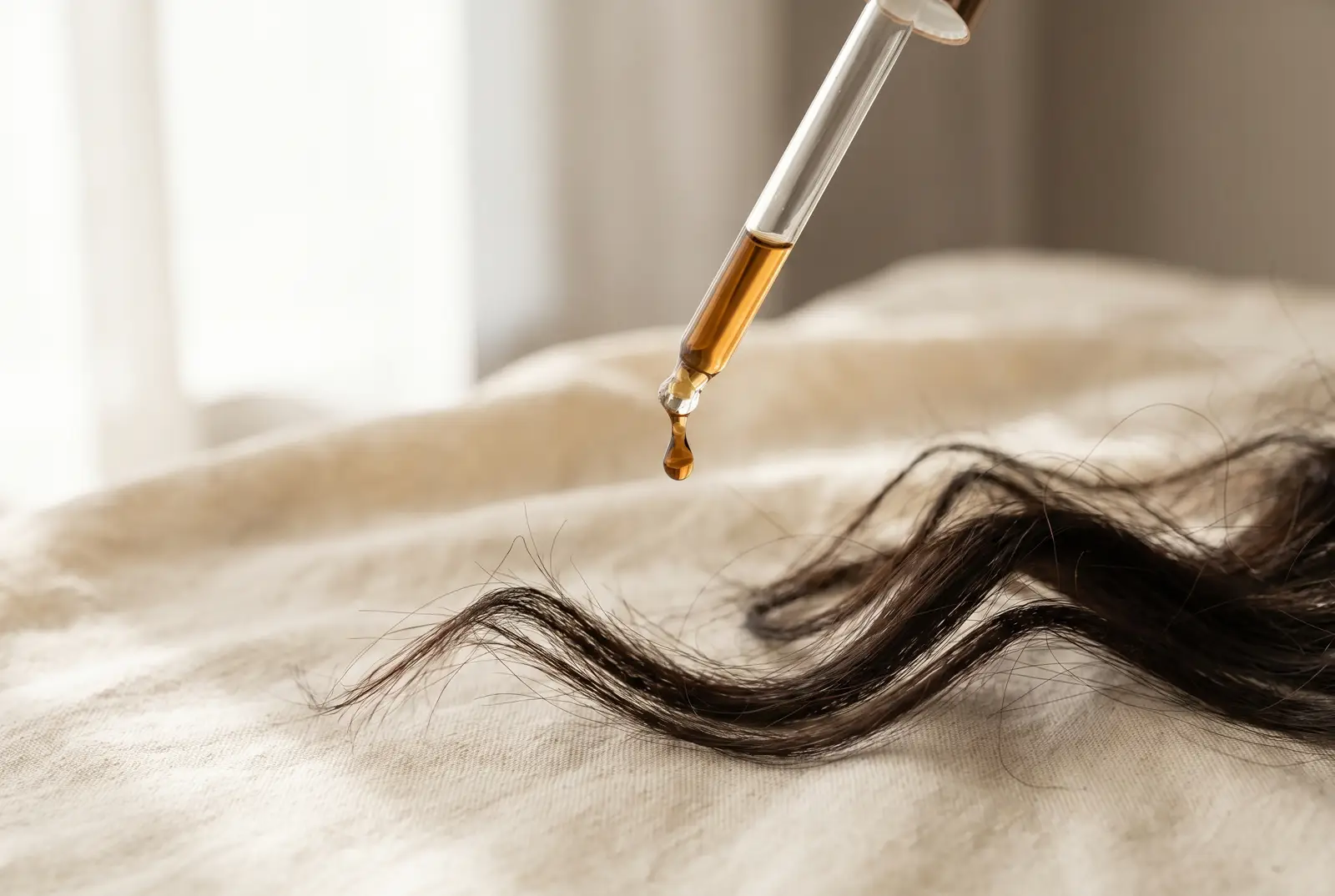
Look for a readable current ingredient list, clear directions, packaging that protects the formula, and an application method that fits your routine. “Pure” and “formulated” are different product types; neither word alone tells you which will feel best on your hair.
Article eyebrow: ARGAN OIL GUIDE
# What Is the Best Argan Oil for Hair? How to Choose
The best argan oil for hair is the one whose formula, directions and finish match the way you plan to use it. Start by checking the ingredient list, bottle size, application instructions and whether the product is a pure oil or a formulated hair oil. Then choose the smallest useful amount for your hair's length and density.
An overnight pre-wash method needs a different dose from a one- or two-drop finishing method. Fine hair usually needs a more cautious start than dense or very dry lengths. And a heat-protection claim belongs to a specific tested product, not to every bottle with “argan” on the front.
Primary CTA: Compare the Four Argan Methods
Link: #four-ways-to-use-argan-oil
Secondary CTA: Explore Celine Claire Moroccan Argan Oil
Link: /product/morrocan-argan-oil/
What is argan oil?
Argan oil is obtained from kernels of the fruit of the argan tree, Argania spinosa, which is closely associated with Morocco. Cosmetic argan oil contains a mixture of fatty acids; published compositional research commonly identifies oleic acid and linoleic acid as the most abundant, followed by smaller proportions of other fatty acids.
Those compositional facts describe argan oil as an ingredient. They do not guarantee that every retail hair oil contains the same concentration, follows the same processing method or creates the same finish. A finished product may be pure argan oil, or it may combine argan oil with other conditioning and styling ingredients.
The practical question is not whether one category is morally “cleaner.” It is whether the formula, instructions and finish suit your intended use.
Pure argan oil versus an argan-based hair oil
| What to compare | Pure cosmetic argan oil | Formulated argan hair oil |
|---|---|---|
| Ingredient list | typically one INCI ingredient when genuinely single-ingredient | may combine argan oil with conditioning, slip, fragrance or stability ingredients |
| Texture and spread | depends on the oil and processing | can be designed for faster spread, slip or a lighter sensory finish |
| Directions | often broad and quantity-sensitive | should be written for the specific finished formula |
| Heat protection | never assume it | use only when the finished product carries a supported heat-protection claim |
| Best choice | depends on the person and method | depends on the person and method |
Health Canada requires cosmetics sold in Canada to carry an ingredient list using International Nomenclature of Cosmetic Ingredients, along with directions, warnings and other required label information. Read the current package rather than relying on a marketplace headline or an old blog post.
Natural and synthetic ingredients are both considered suitable for cosmetics when they meet safety requirements and the product is used as directed. A short ingredient list is not automatically proof of better performance, and a longer formula is not automatically inferior.
What can argan oil do for hair?
Argan oil and argan-based formulas are commonly used to improve the cosmetic feel and appearance of hair. Depending on the finished product and method, that may include:
- adding visible shine;
- helping dry lengths feel softer;
- improving slip during careful detangling;
- smoothing the appearance of frizz and flyaways;
- making ends feel more conditioned;
- supporting manageability before or after styling;
- helping reduce the rough feel associated with dryness and repeated styling.
These are appearance, feel and manageability outcomes. They should not be rewritten as permanent biological repair.
Five checks before choosing the best argan oil for your hair
1. Read the full ingredient list
Look for the current INCI list on the bottle or product page. Argania Spinosa Kernel Oil identifies argan oil. If other ingredients appear, treat the product as a formulated hair oil and follow the directions for that finished formula.
If you have a known allergy or sensitivity, check the complete list rather than relying on words such as “natural” or “hypoallergenic.” Health Canada notes that hypoallergenic is not a scientific guarantee that a reaction cannot occur.
2. Choose the method before choosing the amount
A concentrated overnight application and a dry-hair finishing step are not interchangeable. The overnight method can use a measured multi-drop application because it is shampooed out the next morning. A finisher is deliberately restrained because it remains on the visible surface of dry hair.
3. Match the starting amount to density and length
Fine, short or easily weighed-down hair should begin at the bottom of the approved range. Dense, long or very dry-looking lengths may need more distribution, but adding sections is often more useful than pouring a large amount over the outer layer.
4. Check the bottle and storage directions
The Celine Claire product uses a dark bottle. Keep it closed, away from direct sunlight and excessive heat, and follow the product's stated storage guidance. Packaging can help protect a light-sensitive formula, but the colour of the bottle alone does not prove purity, origin or shelf life.
5. Look for instructions you can actually follow
Good directions name the hair state, amount, placement, whether the product remains in the hair and how often the method is intended to be used. “Apply as needed” is not enough when a small difference in amount can change the finish.
How to choose by hair feel, density and styling goal
Fine or easily weighed-down hair
Start with the lowest amount for the selected method. For leave-in or finishing use, focus on midlengths and ends rather than the roots. Let the hair dry fully before deciding whether another drop would have helped.
Thick or dense hair
Divide the hair into more sections so a small amount can travel farther. Add product gradually. A large amount placed only on the surface can leave the outside coated while the inner sections remain untouched.
Wavy, curly or coily hair
Use the oil for softness, finishing or a documented pre-wash method. Do not expect oil alone to perform the same job as a curl-defining leave-in. If definition and flexible hold are the main goals, compare the dedicated Curl Essence method on the Curls & Texture page.
Colour-treated or lightened hair
Use an argan product only according to its current colour-care positioning and directions. Oil does not replace purple toning care, a rinse-out conditioner or heat protection where a separate product is required.
Dry or damaged-looking ends
Choose between a small leave-in amount and a one- or two-drop dry finish. If the whole wash day needs more moisture, a shampoo, rinse-out conditioner or scheduled mask may be a better foundation than repeatedly adding oil to dry hair.
Four ways to use Celine Claire Moroccan Argan Oil
The following methods belong to Celine Claire Moroccan Argan Oil, product ID 914, SKU CAO100. Do not copy these amounts onto another product without checking its directions.
Method 1: overnight hair-and-scalp mask
- Apply 8–10 drops through the hair and scalp.
- Massage for approximately 10 minutes, covering the hair from roots to ends.
- Wrap the hair.
- Leave the oil on overnight.
- Shampoo in the morning and style as usual.
Choose this when you want a scheduled pre-wash method rather than a visible daytime finish. Do not combine it automatically with the other three methods.
Method 2: shampoo boost
- Place the normal amount of shampoo in your palm.
- Add 1–2 drops of Moroccan Argan Oil.
- Mix between the hands.
- Wash and rinse as usual.
The current detailed directions permit this every two to three days. Adjust the schedule to the actual wash routine rather than washing more often solely to use the oil.
Method 3: leave-in conditioner
- Shampoo and towel-dry the hair.
- Spread 2–3 drops between the hands.
- Apply through the hair, concentrating on areas that need softness or detangling.
- Dry and style as usual.
Current directions position this as a once- or twice-weekly method. Begin lower on fine hair.
Method 4: dry-hair finishing oil
- Start with 1–2 drops.
- Rub the hands together to distribute the oil.
- Lightly smooth it over clean, dry hair, concentrating on lengths, ends or visible flyaways.
- Style as usual.
Do not massage the dry-hair finishing dose into the scalp. Its job is a controlled surface finish.
Should argan oil be used as a heat protectant?
Do not assume every argan oil is a heat protectant. Heat protection is a performance claim for a specific finished product and its tested directions. Celine Claire currently positions Moroccan Argan Oil with heat-protection benefits, but the precise temperature claim remains subject to current package or signed-data confirmation.
When the routine calls for a dedicated protection step, follow the Heat Shield Hair Spray page. More oil is not a substitute for following the amount, placement and tool guidance of the actual heat-protection product.
Is argan oil good for hair loss?
Argan oil may improve softness, shine and manageability, and a conditioned hair shaft may be less prone to some forms of cosmetic breakage. That is not the same as treating hair loss or stimulating new growth.
A 2022 systematic review found no significant evidence supporting argan oil for improving hair growth, hair quality or infestation treatment. For that reason, Celine Claire's established hair-loss positioning must remain carefully framed around conditioning, breakage and healthier-looking hair rather than guaranteed regrowth.
Sudden shedding, patchy loss, scalp pain, sores, marked redness or a continuing change in density needs appropriate professional assessment. A cosmetic oil cannot identify the cause.
Can argan oil help a dry scalp or dandruff?
The Celine Claire overnight method includes the scalp, so it can be used as directed for conditioning. It should not be described as treating psoriasis, seborrheic dermatitis, fungal infection or dandruff.
If the scalp burns, becomes more irritated or develops persistent flaking, stop treating the issue as a simple moisture problem. Use the Scalp Care guide to understand the cosmetic options and when professional guidance makes more sense.
What about face, hands, feet or beard use?
Older Celine Claire content discusses using argan oil on the face, hands, feet and beard. Keep those uses secondary to the hair guide and publish exact directions only after they are confirmed against the current CAO100 package.
For beard use, begin with a clean beard and a small amount, then work through the hair from roots to ends. Do not claim faster or thicker beard growth.
A practical choice: one bottle, one method at a time
Celine Claire Moroccan Argan Oil is designed as a multi-use 100 ml hair oil. The useful part of that versatility is not doing everything at once. It is choosing the method that fits the day:
| If the goal is… | Start with… |
|---|---|
| scheduled pre-wash conditioning | overnight 8–10-drop method |
| adding oil to the cleansing step | 1–2-drop shampoo boost |
| softness after washing | 2–3-drop leave-in method |
| shine or flyaway control on dry hair | 1–2-drop finishing method |
Product CTA: Explore Moroccan Argan Oil
Link: /product/morrocan-argan-oil/
Routine CTA: Follow the Argan Hydration Routine
Link: /routines/argan-hydration-ritual/
Frequently asked questions
Which argan oil is best for hair?
Choose one with a current ingredient list, clear directions and a finish suited to your method. Decide whether you want a pure oil or a formulated hair oil, then match the amount to your hair's length and density. No single bottle is automatically best for every texture or use.
Is pure argan oil always better?
No. Pure argan oil and formulated argan hair oils are different product types. A formula may add slip, spread or a particular sensory finish. Read the INCI list and directions, then judge the product by its intended use rather than assuming the shortest list always performs better.
Can I use argan oil every day?
Follow the frequency for the selected product and method. Celine Claire's current instructions attach every-two-to-three-day use to the shampoo-boost method, once- or twice-weekly use to the leave-in method and weekly use to the overnight mask. Dry finishing should begin with one or two drops.
Should argan oil go on wet or dry hair?
It depends on the method. Celine Claire's leave-in method follows shampooing and towel-drying. Its finishing method goes on clean, dry hair. The overnight method covers hair and scalp before shampooing the next morning. Do not merge the amounts or instructions.
How much argan oil should I use on fine hair?
Begin at the lowest approved amount. For Celine Claire's dry-hair finish, start with one drop through the lengths and ends. For leave-in use, start below the maximum two-to-three-drop range and assess the fully dry result before increasing the next application.
Can argan oil make hair greasy?
Yes, particularly when too much is placed near the roots or layered repeatedly. Start small, distribute the oil between the hands and concentrate leave-in or finishing use through the lengths and ends. Use more sections before using a much larger total amount.
Does argan oil grow hair?
There is no strong clinical evidence that cosmetic argan oil stimulates hair growth. It may support softness, shine and manageability and may help hair look healthier by reducing roughness or some cosmetic breakage. Persistent, sudden or patchy hair loss needs appropriate professional assessment.
Does argan oil repair split ends permanently?
No cosmetic oil permanently rejoins a physically split hair fibre. Oil may make the ends feel smoother and look more polished temporarily. Regular trimming, careful handling and reduced styling damage remain relevant when ends are already split.
Can argan oil replace conditioner?
Not automatically. A small oil amount can function as a leave-in method when the product directions support it, but it does not perform the same wash-day job as every rinse-out conditioner. Choose the sequence based on the complete routine and the hair's response.
Can I use argan oil before blow-drying?
Only follow the heat-protection directions of the exact finished product. Celine Claire positions its Moroccan Argan Oil for use before or after blow-drying, while a precise temperature badge still needs current documentation. Use a dedicated Heat Shield step when the routine requires it.
How should I store argan oil?
Keep the bottle closed and away from direct sunlight and excessive heat. Celine Claire uses a dark-coloured bottle. Packaging can help protect the formula, but bottle colour alone does not confirm the product's purity, manufacturing origin or exact shelf life.
# Internal linking plan